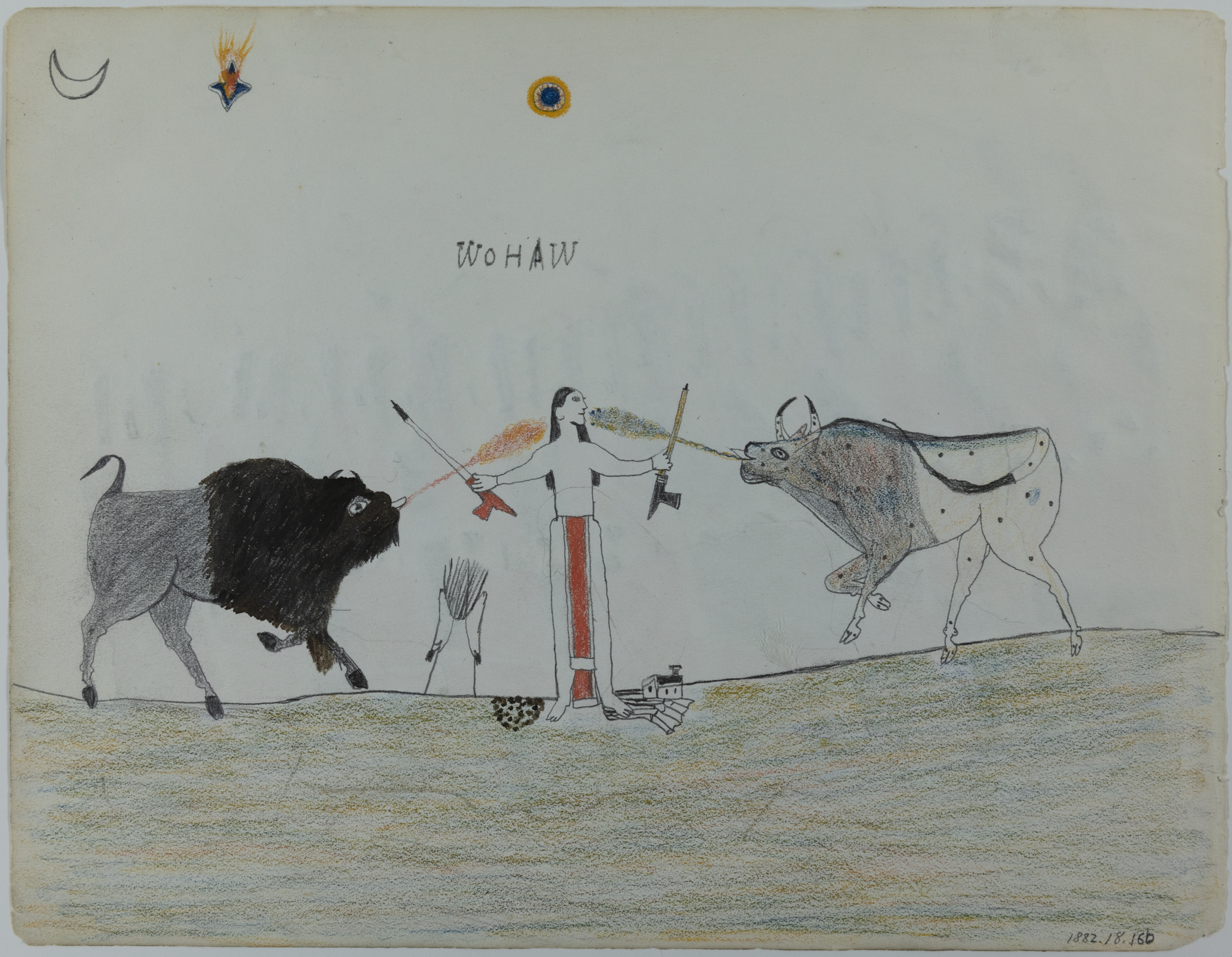
Longhorn and Buffalo
Ethnographic Notes
Under Wohaw’s autograph, a man dressed in a breechclout, is flanked by buffalo and longhorn males, each sending their breath in his direction. Small images of a tipi and buffalo herd on the left, and a farmhouse and farmland on the right, appear between the man and animal. Wohaw’s drawing is one of the most well-known and often reproduced works from Fort Marion. Previously titled “Between Two Cultures,” scholars Karen Daniels Petersen, Janet Berlo, and Moira Harris interpreted the drawing as a self-portrait of Wohaw facing a choice between two cultures–Native culture or white society– represented by the buffalo and longhorn bull, respectively. However, Candace S. Greene shows that Kiowa community members interviewed in the 1930s recognized the drawing as “a spiritual quest or an actual transfer of power.” In Kiowa culture, both buffalo and longhorn cattle hold great spiritual power, which could be transmitted through breath during ceremony. Wohaw is not caught “between two cultures.” Earlier interpretations misrecognized the meaning in Wohaw’s drawing; he receives spiritual power from both animals! The Kiowa had integrated longhorn cattle into their belief system on their own terms before both reservation life and the assimilation project that Wohaw experienced at Fort Marion.
Greene, Candace S. “Buffalo and Longhorn: A Medicine Complex Revealed.” American Indian Art Magazine 38(4): 42–53, 2013.
Greene, Candace S. "Being Indian at Fort Marion: Revisiting Three Drawings." American Indian Quarterly 37(4):289-316, 2013. doi: 10.1353/aiq.2013.0052.